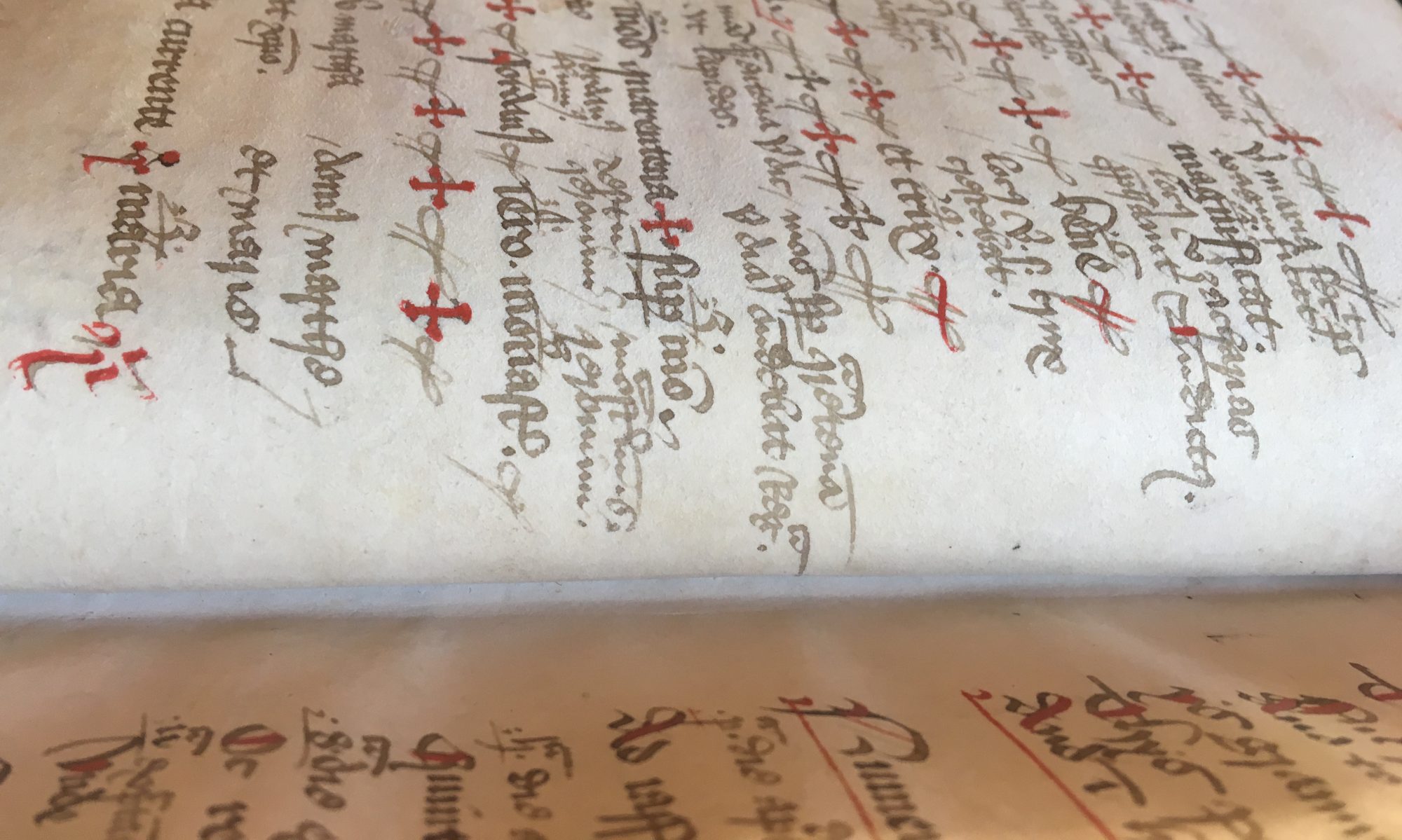
We are pleased to trial a new session, once or twice a month, in which readers of medieval manuscripts can pose questions to a mixed group of fellow readers and Bodleian curators in a friendly environment. Come with your own questions, or to see what questions other readers have!
Teaching the Hybrid Text: An Example
Oxford, Trinity College, MS 29 has a bit of everything when it comes to hybridity, which makes it a very useful object with which to challenge students to think outside of the categories with which they are often presented in courses on the medieval period, such as medieval vs Early Modern, manuscript vs print, parchment vs paper, or verse vs prose.
Teaching Jawi in the pandemic
Mulaika Hijjas is Senior Lecturer in South East Asian Studies at SOAS University of London, where she teaches literature and cultural studies of the region. She is the principal investigator of Mapping Sumatra's Manuscript Cultures, funded by a Leverhulme Research Leadership Award. Follow the project on Twitter or Facebook. Jessica Rahardjo is a DPhil candidate …
Robinson Ellis and the teaching of Palaeography in Oxford
David Ganz was Professor of Palaeography at King's College London from 1997-2010. In 2016, he was elected a Corresponding Member of the Monumenta Germaniae Historica. This post contains a reference to attempted suicide. In 1885 a slim volume, entitled XII Facsimiles from Latin MSS in the Bodleian Library, was published by Oxford University Press. [1] The …
Continue reading "Robinson Ellis and the teaching of Palaeography in Oxford"
Teachable Features 14: Working with Digital Objects: Digitization as a Teachable Feature, or “How did Those Images Get There?!?!”
Astrid J. Smith has been digitizing materials as rare book and special collections digitization specialist for Stanford Libraries for over a decade. With a background in fine art, and a master’s degree in liberal arts, she strives always to ensure that cultural heritage preservation imaging best practices are combined with her own aesthetic and phenomenological …
Teachable Features 13: Decorative Features in Medieval Manuscripts
Dr Sian Witherden outlines a series of decorative manuscript features. Sian is a Rare Books and Manuscripts specialist. This post also appears on the St John's College blog. I recently joined the St John’s College (Oxford) library team to work on the TEI project, my main role being to incorporate existing catalogue records into the …
Continue reading "Teachable Features 13: Decorative Features in Medieval Manuscripts"
From the Holy Land to the Bodleian: Arnold von Harff’s travelogue travels to Oxford
Aysha Strachan is a PhD student in German at King’s College London/Humboldt University Berlin supervised by Sarah Bowden and Andreas Krass and funded by the LAHP. She completed the MSt. at Oriel College, Oxford in 2019 and took the History of the Book method option to complement her research into the depiction of transgressive women …
Navigating Biblical Manuscripts 2: Breviarium
John Zachariah Shuster studies reception history of the Bible at the Hebrew University of Jerusalem. This is the second of a series of three posts exploring the tools built into biblical manuscripts to help their medieval users find their way around. In my last post, I wrote about the Eusebian Canons in the Herzog August …
Continue reading "Navigating Biblical Manuscripts 2: Breviarium"
Follow the Reader: a Virtual Exhibition Highlighting Manuscript Margins
Mariken Teeuwen is senior researcher at the Huygens Institute for the History of the Netherlands (Royal Netherlands Academy of Arts and Sciences), and Professor at the Department History and Art History of Utrecht University. Between 2016-2020, Irene van Renswoude, Irene O’Daly, and I worked together on a project titled The Art of Reasoning: Techniques of …
Continue reading "Follow the Reader: a Virtual Exhibition Highlighting Manuscript Margins"
Creating Public Awareness of the Bestiary in Merton College Library, MS 249
Sebastian Dows-Miller is an MSt candidate at Merton College, Oxford. He has a particular interest in text transmission within manuscript culture, as well as short texts written in Old French, and is always very pleased when the two intersect. Follow him on Twitter here, or follow Merton Beasts directly. The bestiary genre is well known, …
Continue reading "Creating Public Awareness of the Bestiary in Merton College Library, MS 249"
 Teaching the Codex